Wizardry fans have been eating well for some time now. After a classic dungeon crawler drought in the 2000s, the 2010s onwards has seen the DRPG go through an explosion with inventive revivals like Legend of Grimrock (2014), ambitious narratives like Labyrinth of Refrain (2016) and clever deconstructions like DUNGEON ENCOUNTERS (2021) to name a few. Wizardry itself has had multiple entries during this period like Wizardry: Labyrinth of Lost Souls (2020) and Wizardry Variants Daphne (2025) and it's shadow looms large over even fantasy works like Delicious in Dungeon and Tower Dungeon outside of video games. Many creators see the potential storytelling space between its signature abstractions.
Now in the late 2020s, indie developers are the ones delving into new spaces for the maturing DRPG genre. Want a chill experience that lets you just fill out a map? Try Dragon Ruins II (2025). Want to break out the grid paper and navigate oldschool UI? Jettatura (2022) has you covered. Want action-packed real-time battles in between your slow methodical crawling? Look no further than Path of Abyss (2025). In this era of experimentation and uncovering new niches, it was inevitable someone would combine the ever popular roguelike genre with the high variance gameplay of Wizardry.
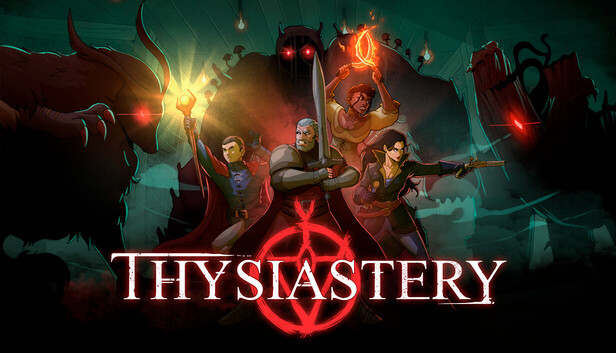
THYSIASTERY (2026) is the debut game of developer DIRGA, a five person studio based in Espoo, Finland. The game has you take on the role of a lost soul branded for sacrifice and trapped in the mysterious titular labyrinth. You must scrounge for survival, carefully engage with enemies and make tenuous allies with other souls who share your fate. Navigation and Combat are both turn-based and take place on the dungeon floor itself, rather than going into a separate instance (leading to a dynamic similar to that of the Mystery Dungeon series). While dungeon floors are procedurally generated each run, you still go through the same four strata each time, so you have some idea of what hazards and rewards you will encounter. If you had to put a label on the game: it is a Wizardry Roguelike with an emphasis on randomized characters and skill pools. But that doesn’t even scratch the surface of the experience of playing the game, so let’s delve deeper to see what makes it special.
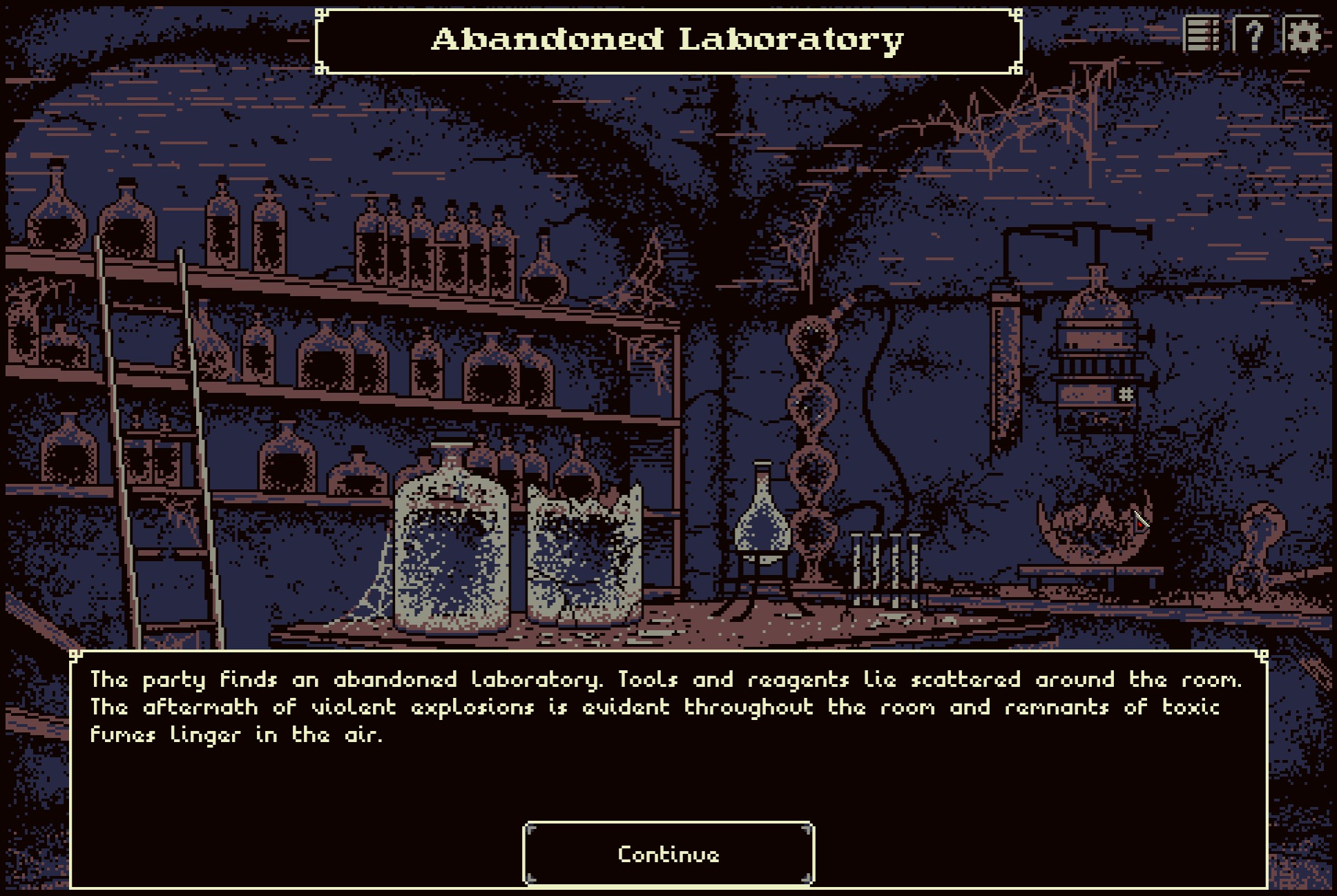
The first stratum of the THYSIASTERY experience is its arresting atmosphere.
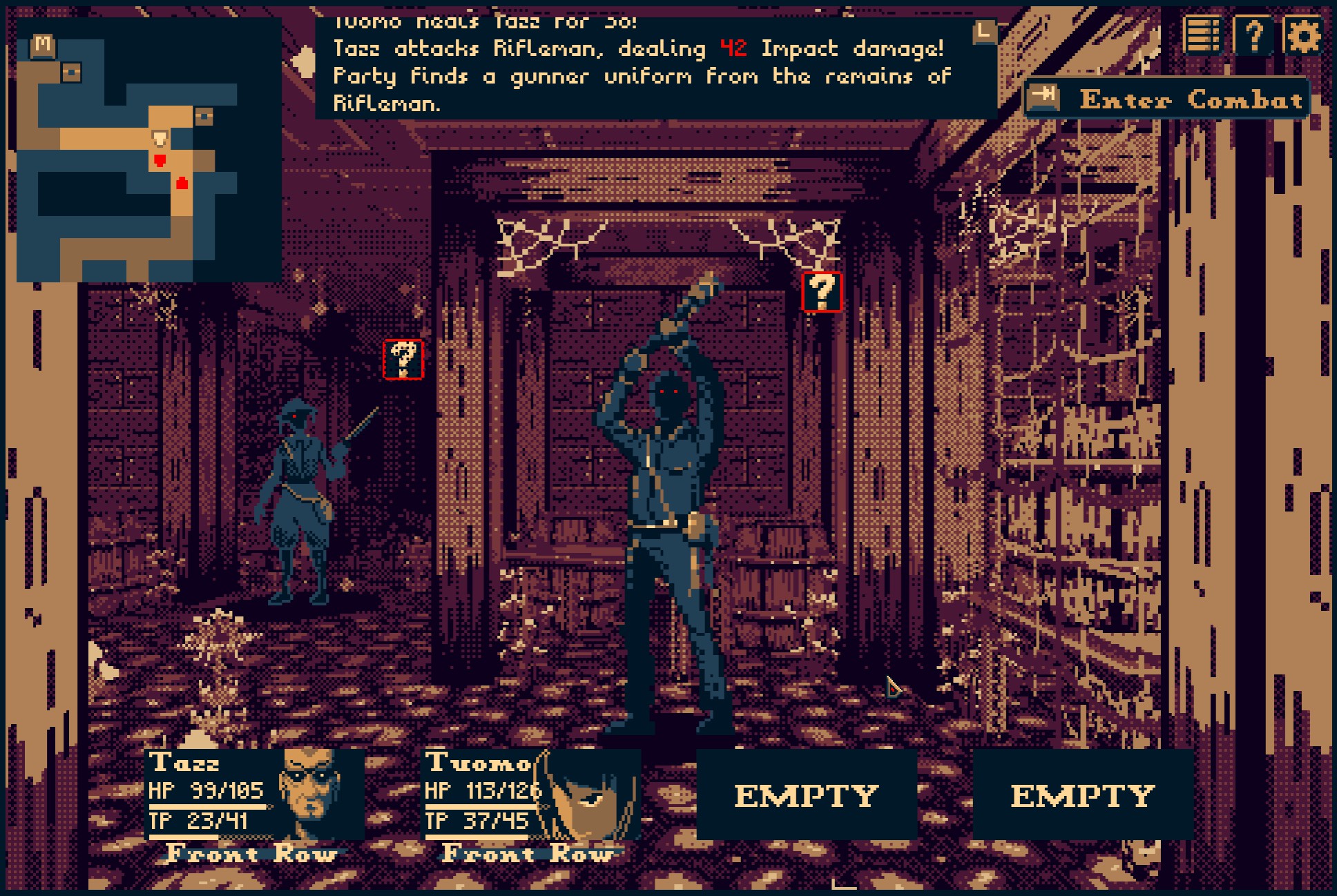
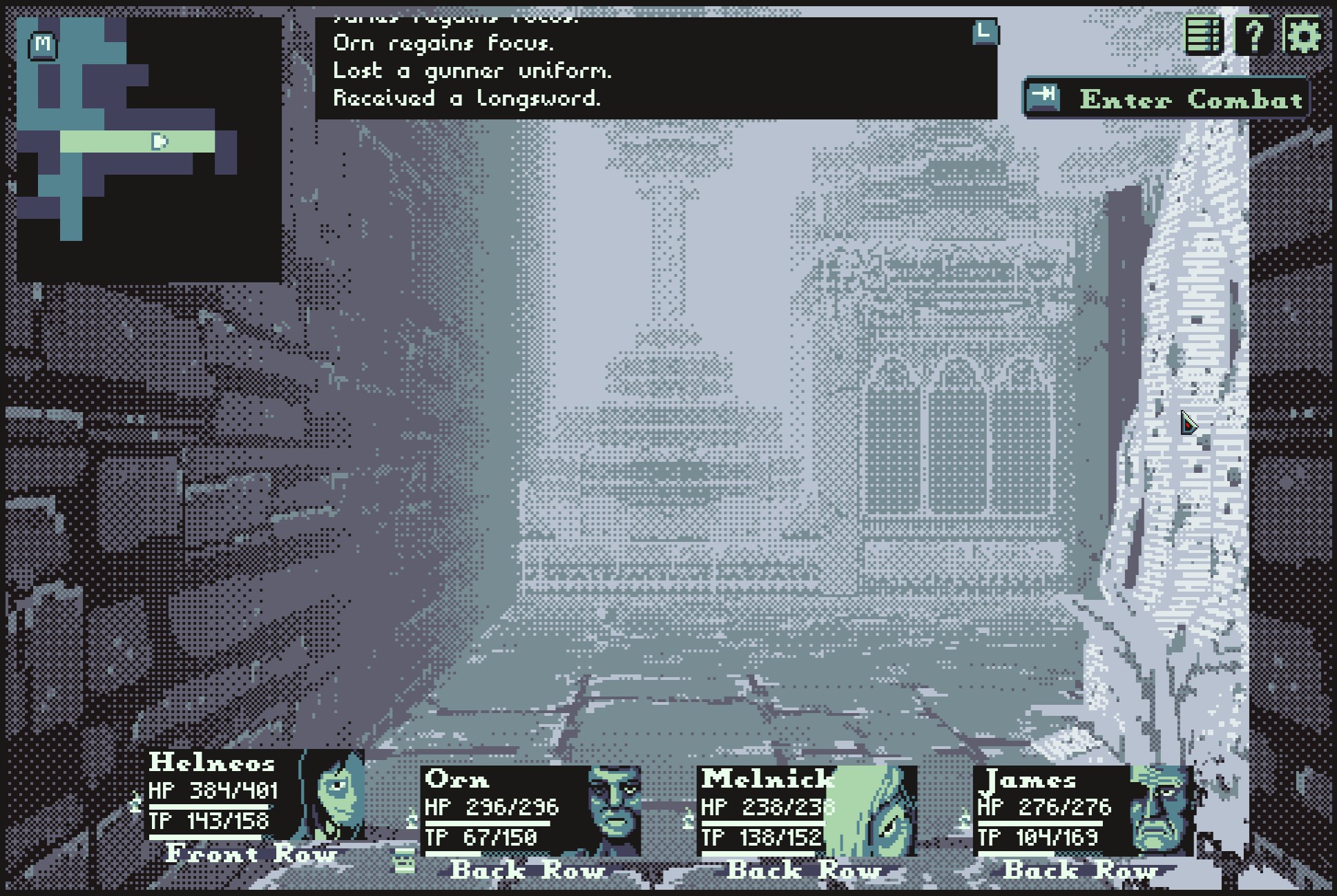
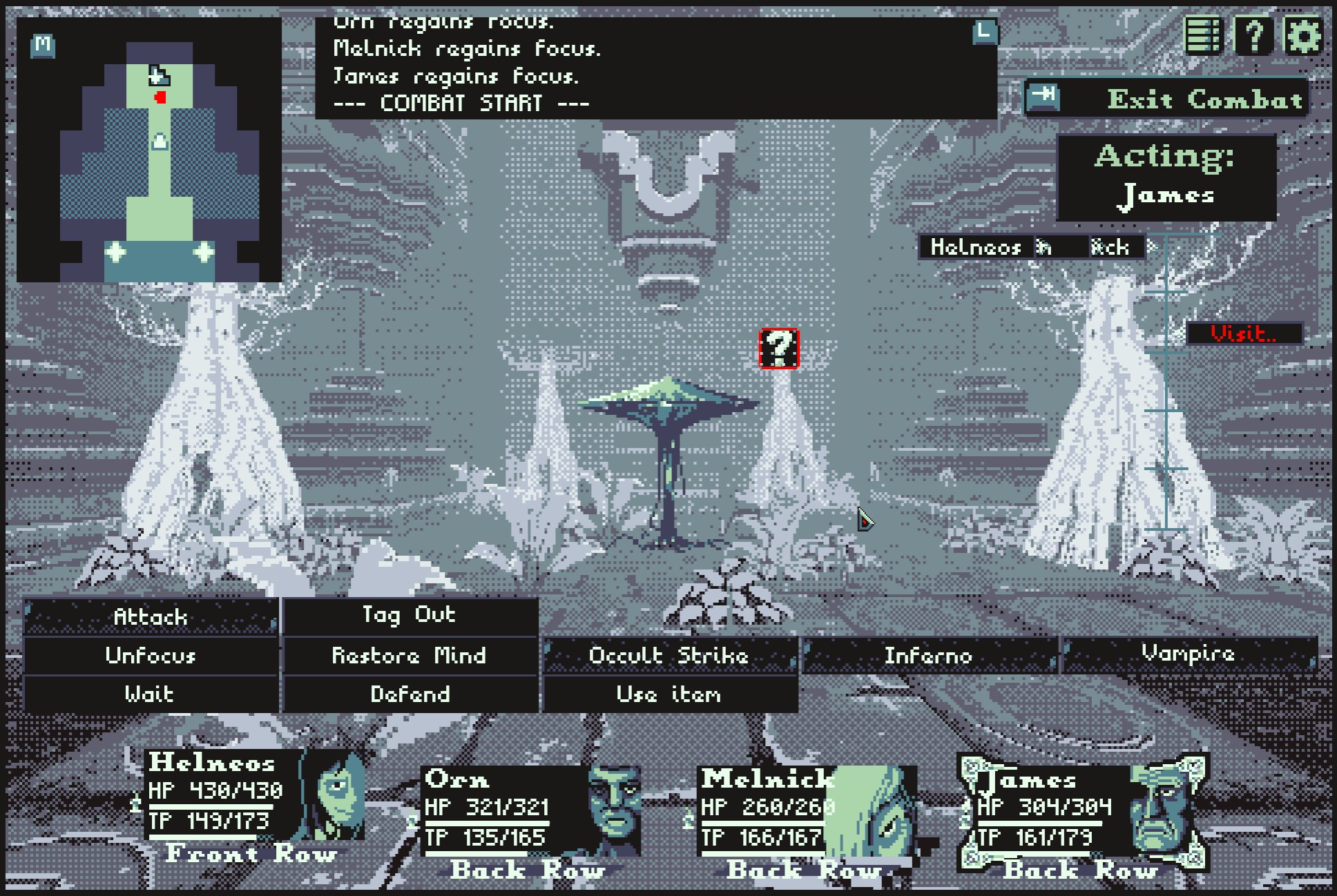
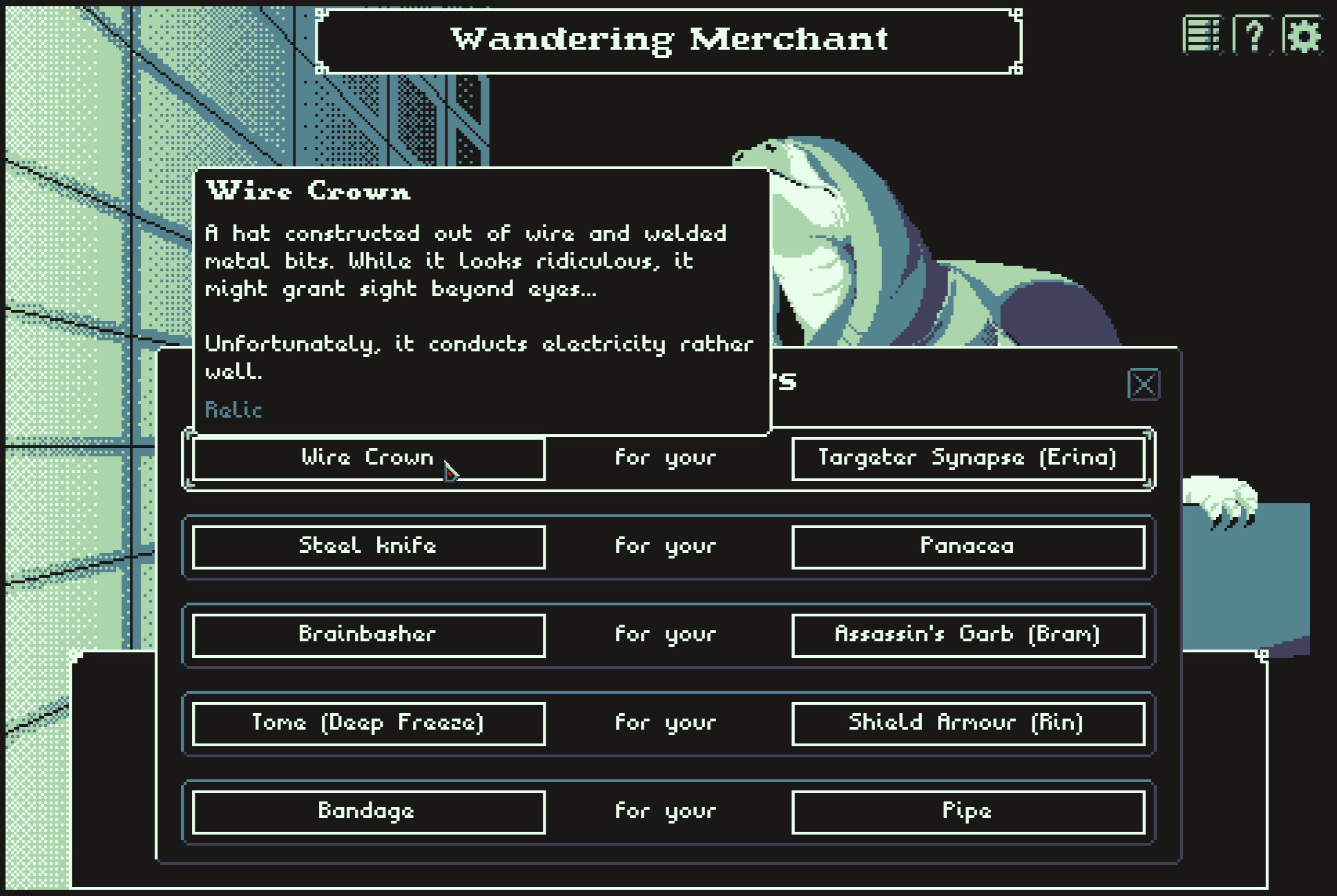
Limited color palettes are a go-to style for many indie developers as it is an easy way to generate eye-catching screenshots that help their games stand out on storefronts. THYSIASTERY changes its palette to match the mood for each stratum: from the purples and yellows of the first stratum’s trench tunnels to the whites and light greens of the fourth’s temple ruins; you are given a kaleidoscopic tour that will make you pause in awe to take in the view. Smartly, the developers allow you to override the palette in the Options menu so players can play around with different moods and also may provide accessibility for color-blind players.
Character portraits are simple, limited impressions of various persons cast in the light of a campfire. There is enough detail to suggest who they might have been before they were consigned to the labyrinth, but you can never tell for sure. Your enemies are not Giant Rats or Kobolds or other cameos from the D &D Monster Manual, but undead soldiers fighting a war that has gone on too long. Wizardry-likes tend to lean either into the macabre or overly cheery in a way that can be unappealing or even gross at times. THYSIASTERY’s enemies and environments send a different message: this is a world at war. No one knows when it started or when it will end. Everything is warped by its horrors. Even if you escape this infernal labyrinth, you may just be returning to a hell of mortal creation.
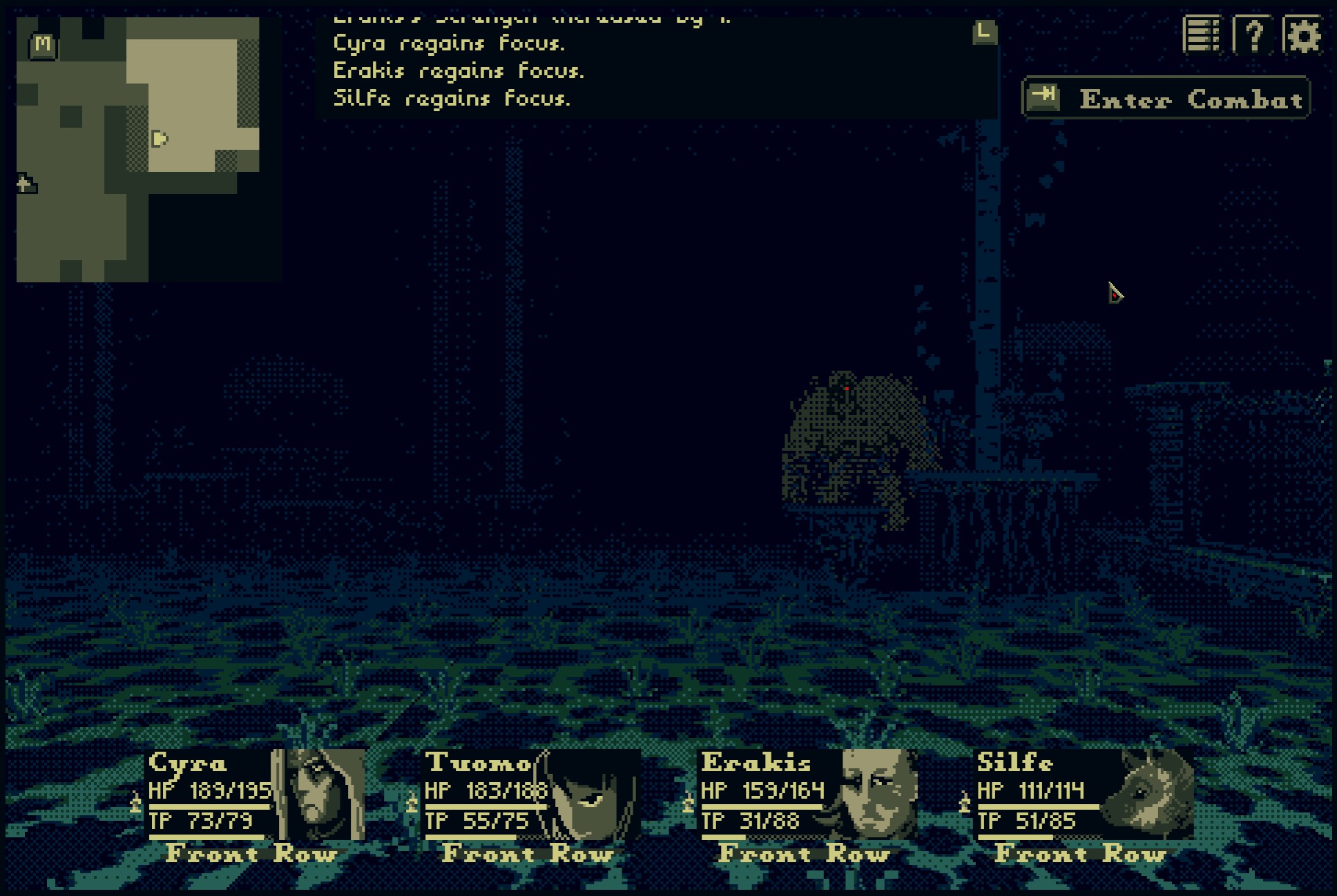
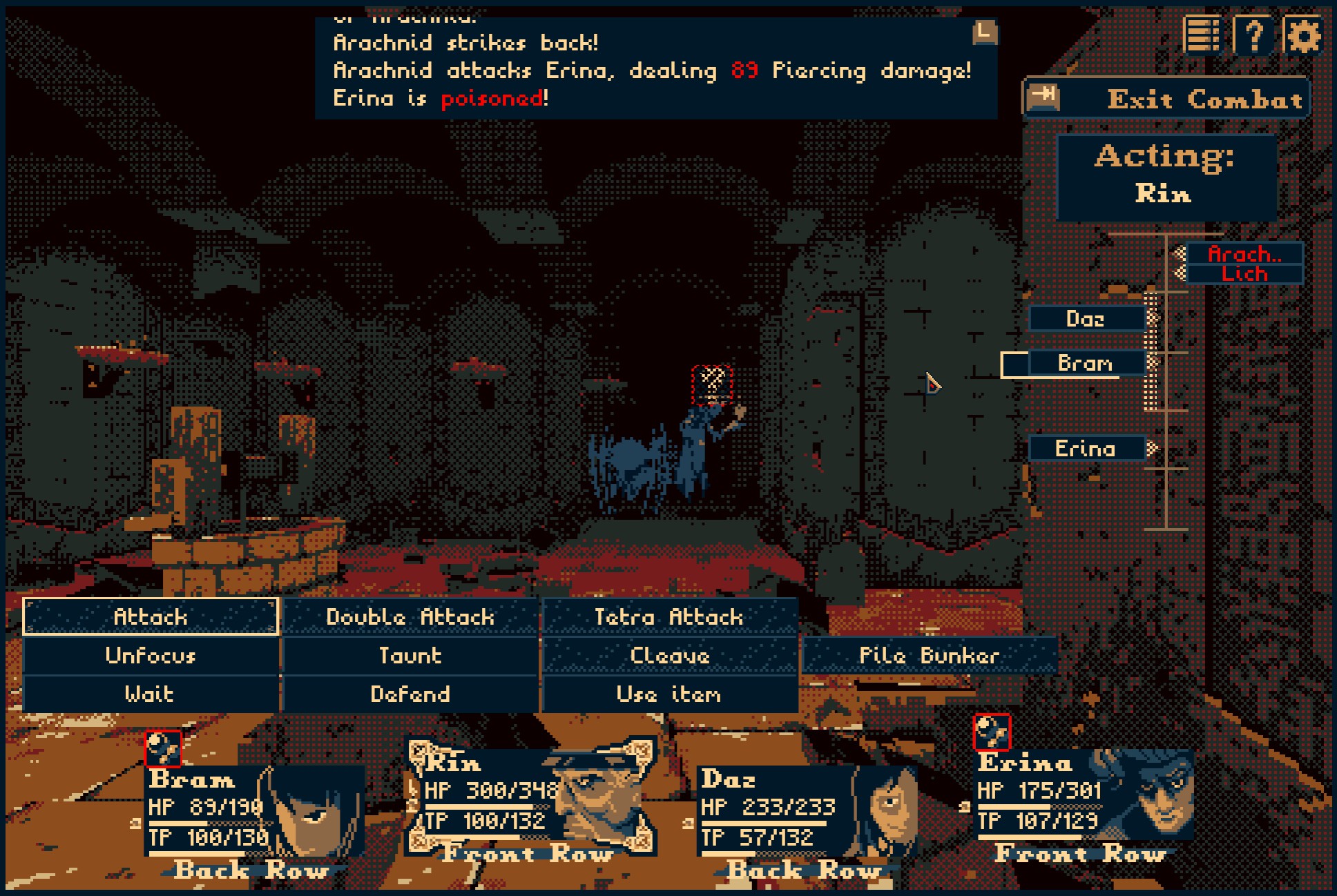
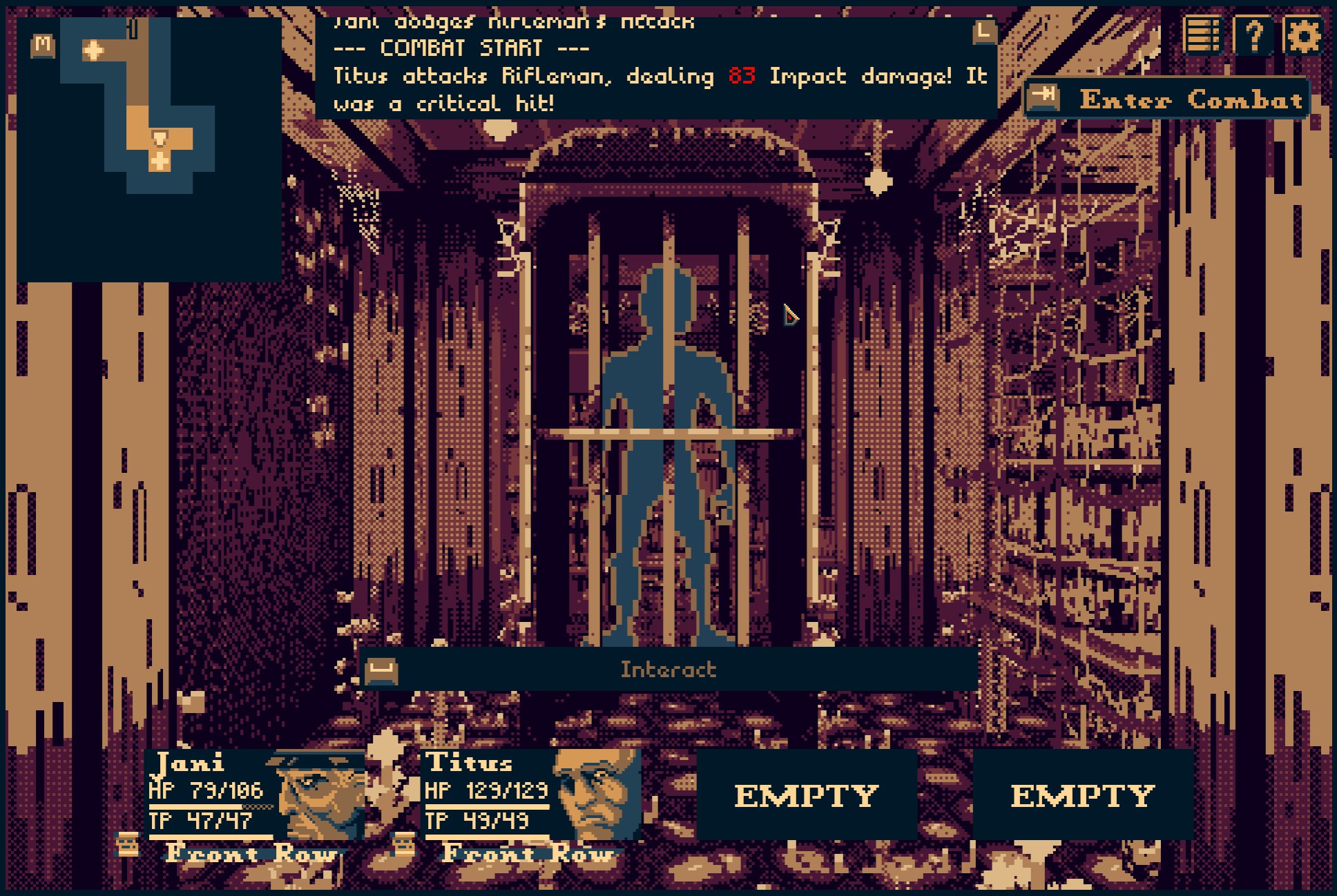
The visual lynchpin of THYSIASTERY is its dither fog system, which overlays the scene and is used to showcase the party’s range of vision in a given space. Distant elements like enemies and points of interest (POIs) will have a dithering effect on them for each tile away, making them haunting silhouettes and malformed shapes in the dark. More than once I had a mild jump scare as I turned my camera and I thought I saw another enemy coming my way, only for it to be a trick of the render. What enhances this visual effect further is how the fog goes in and out like a wave and changes how elements are obscured, giving the labyrinth an eerie sense of life as though it is “breathing”. It reminded me of Quake’s sense of unease, where the screen swims a little and your crosshair never comfortably rests in one place.
THYSIASTERY’s soundscape is bold and demands your attention. The blare of an otherworldly horn starts your game and the droning ambience that fills your ears keeps you in a state of constant anticipation. When the exploration ambience kicks into its combat layer, you are desperate to bring its frenetic chaos to an end and return to your regular sense of unease as safety. Of particular note are the fourth stratum’s themes, which make use of gamelan instrumentation to complement the South-East Asian inspired temple ruin you are exploring, making that segment feel ethereal and dream-like. When enemies force you into combat, you never want to be hearing the dread march of the boss theme, as that may spell doom for your party. The only reprieve from this is the slow mournful dirge of the campfire that plays as you have to loot the corpses of your dead party members to prepare for your next outing.
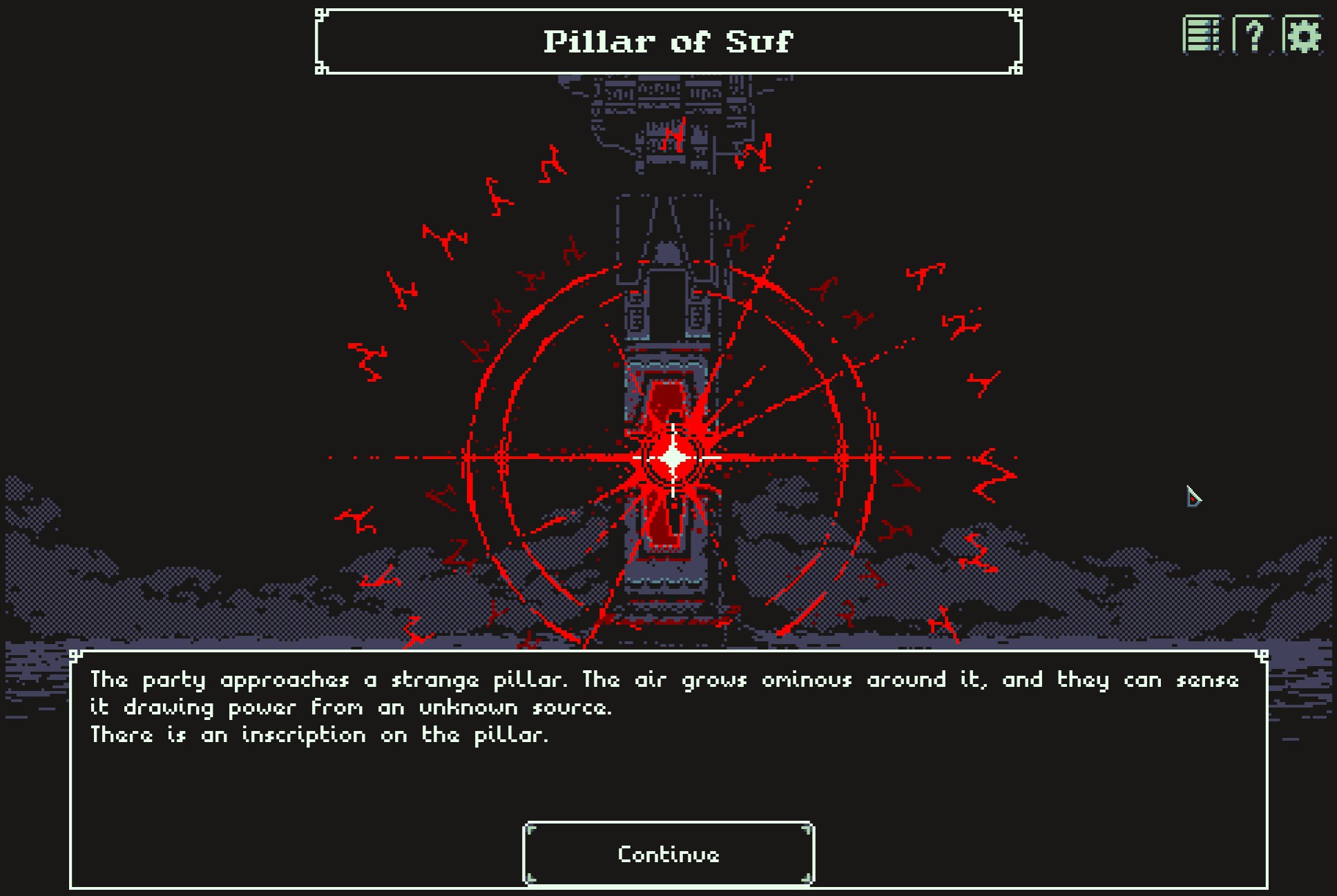
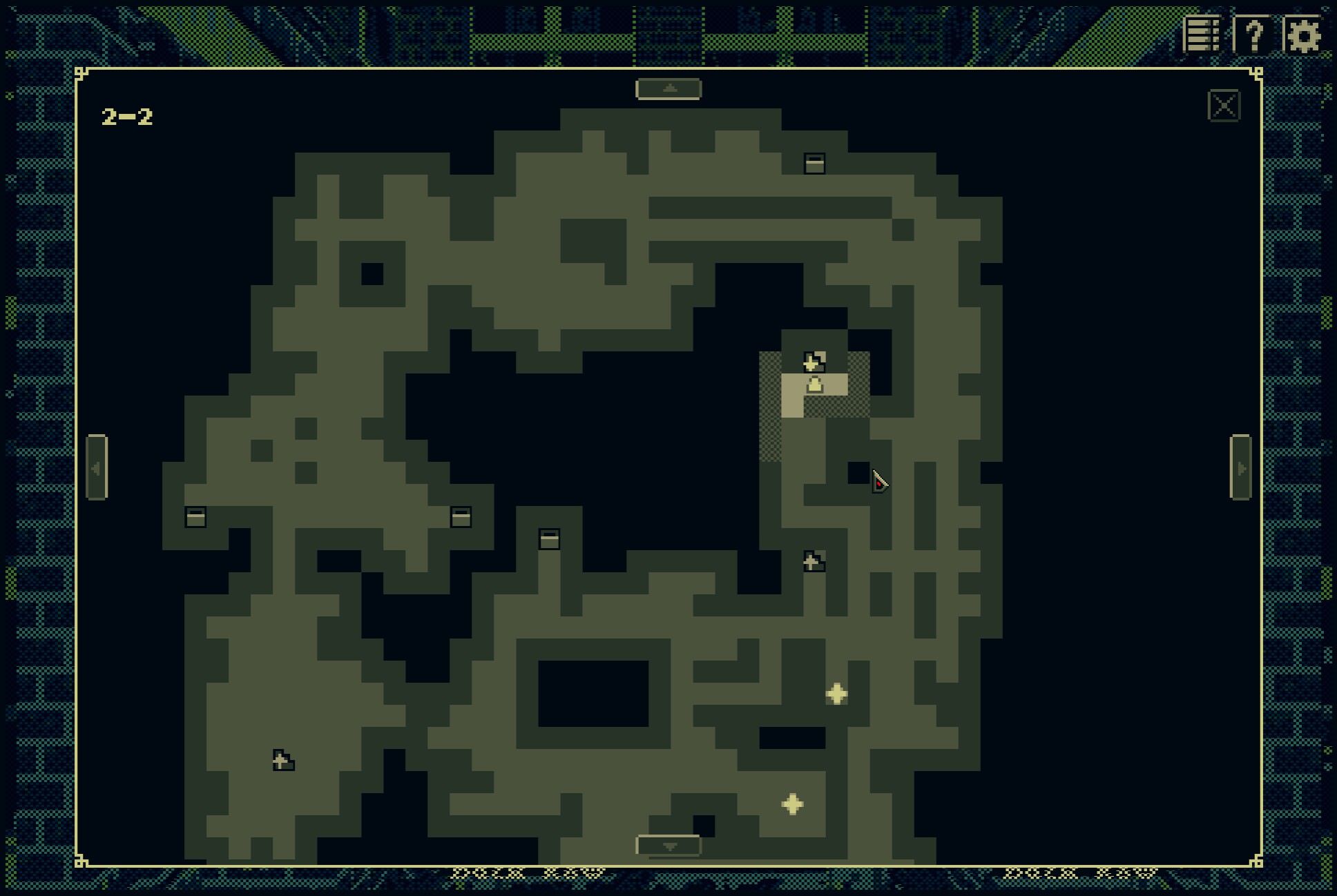
Procedural generation is a dirty word within the dungeon crawler community. While it is tolerated in some games, many oldheads consider it an abdication of one of the core tools designers can use to hand craft their experience. This is understandable as for the longest time the most memorable parts about dungeon crawling was the adversarial relationship between designer and player as the designer implemented new ways of messing with players and the players innovated counter methods to overcome those challenges. Procedural generation abstracts the designer’s side of that two-way relationship where the intentionality happens in the meta-design of floors rather than the nitty gritty of the corridor by corridor, enemy by enemy, item by item, trap by trap implementation.
THYSIASTERY’s implementation of procedurally generated dungeons has two things going for it: that the floors are relatively dense, and that each stratum is a set of three floors that are vertically linked to each other. The floor density means that it won’t be too long before you run into something and that you will be able to map out floors much faster than in most classic dungeon crawlers. The vertical links between floors are important as they add another dimension to shortening your runbacks to the campfire. They are also a tool to escape enemies who won’t chase you past the floor they are currently on. While I was worried that the procedural generation would make the levels feel too samey, that ended up not being the case. There are enough landmarks that I was able to complete a run without the Map (which can be turned off) via orienteering. Navigating did take a few turns longer than usual, which comes at a cost I’ll discuss later.
For those DRPG oldheads who are skeptical of procedural generation, I would humbly ask to give this game’s take on it a shot. While it might not change your overall stance on the use of procedural generation in dungeon crawlers, what’s been implemented here is in keeping with the game’s design pillars. There is clear intent put into the design of each stratum, with different level layouts emphasizing atmosphere (the winding claustrophobic trench tunnels of stratum 1 versus the wider organic forest groves of stratum 2, for example). The local enemies are also set up to take advantage of those floor differences. Once we get into how combat works, you’ll see why having fixed floor layouts could have resulted in a much less interesting game. This issue can actually be seen on the boss floors which are currently static and solvable; then again, perhaps it was a necessary concession to make for a more deliberate authored experience.
The second stratum of the THYSIASTERY experience are its cryptic systems.
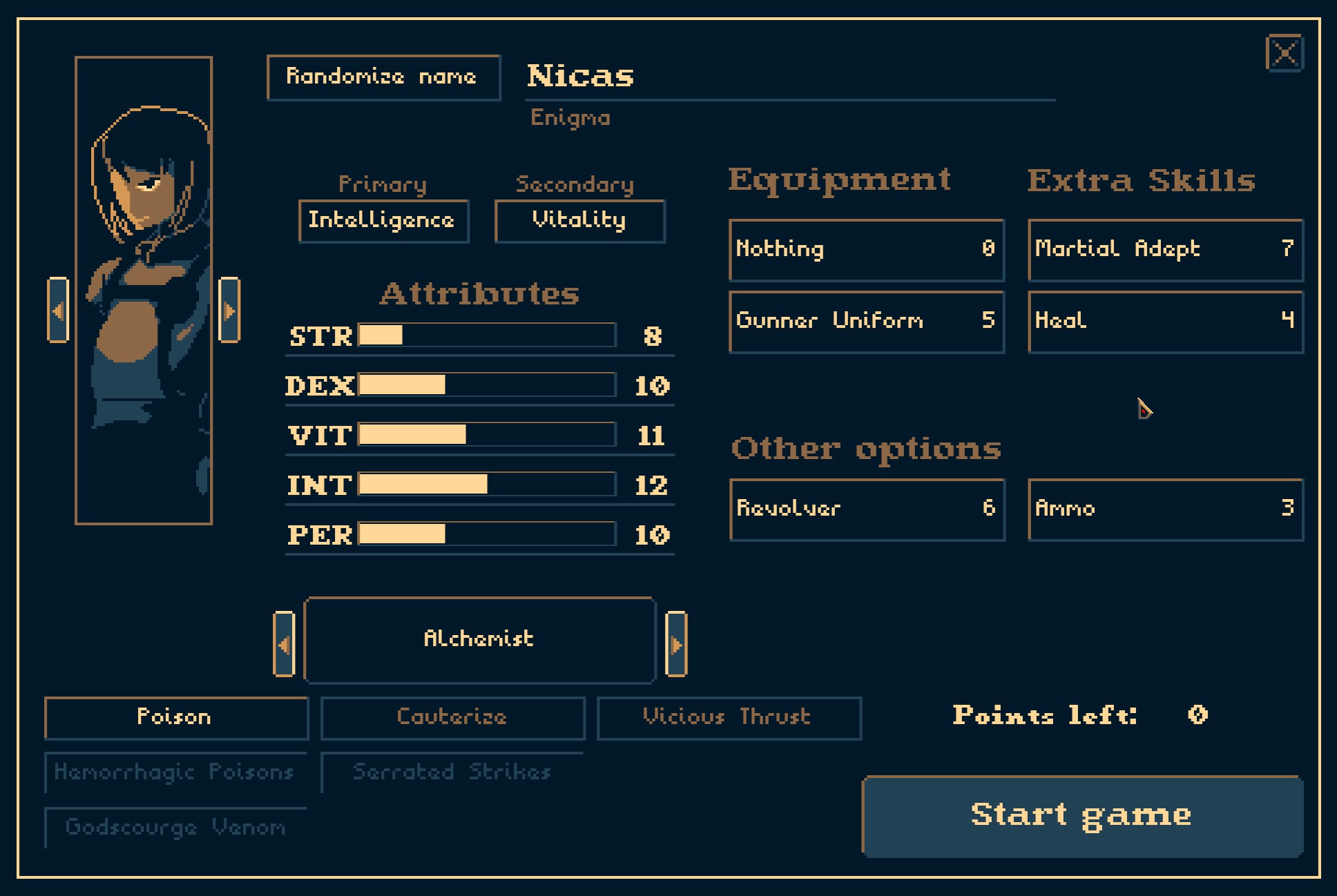
One of the features of Wizardry that often falls by the wayside in modern takes is its randomized character creation: rolling for stats, alignment, skills, starting gear, gold etc. Some Wizardry entries were also infamous in that on leveling up, your stats could randomly go down rather than up. Nowadays stat growths are often tied to a character’s Class or player determined through point assignment. You can expect a Fighter-type to have decent STR or VIT and only focus on DEX or CHA if you are feeling saucy.
THYSIASTERY, though, fully embraces Wizardry’s character randomization and all the frustrations that come with it. It only gives you (optional) control over the first party member’s initial stats, skills and gear. Every subsequent character you recruit in the labyrinth will have randomized loadouts scaled to your average party level. This often results in characters that might appear unoptimized or even functionally useless for your party, like running into another Healer when you already have 3 Healers. You can even die on the first floor if your randomly generated character runs into items and enemies in the wrong order.
This heavy use of randomness is further complicated by THYSIASTERY’s skill system. Instead of Classes, each Character has a Skill Group which is a set of 3 Tier-1 Skills, 2 Tier-2 Skills (learnable after Level 4) and 1 Tier-3 Skill (learnable after Level 12). The Skills in each group follow a general theme, such as Guard having Taunt or Healer having Heal. The other skills will be randomized from a pool so that no two Guards and Healers will have the exact same skills for a given run. Characters accumulate Advancement Points (AP) through levelling up or dungeon events which can be spent to learn these Skills. Learning is not instantaneous and usually takes 1 - 3 battles depending on the Tier of the Skill. Skills learned outside of your Skill Groups usually go into the 2 - 4 Extra Skill slots each Character has.
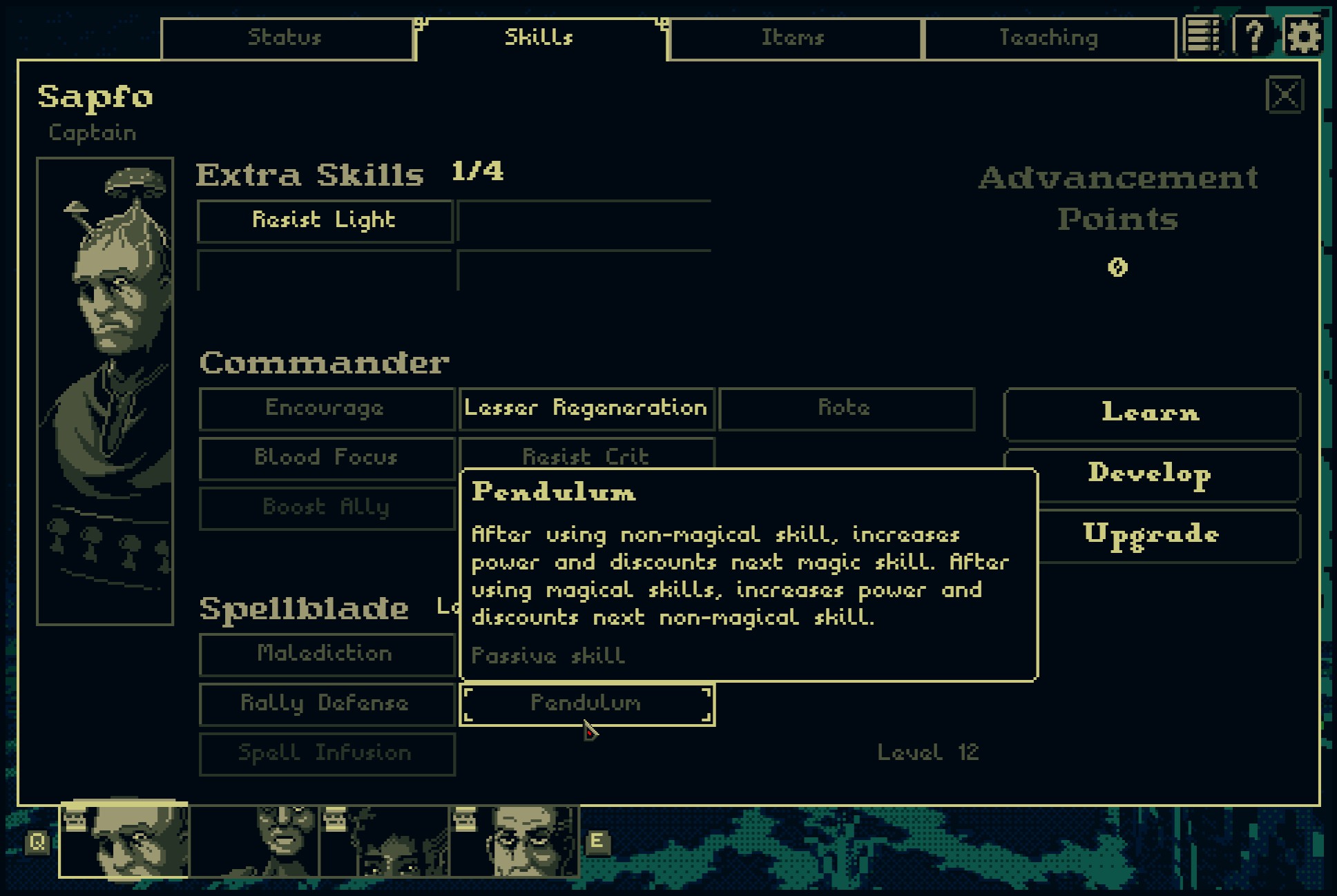
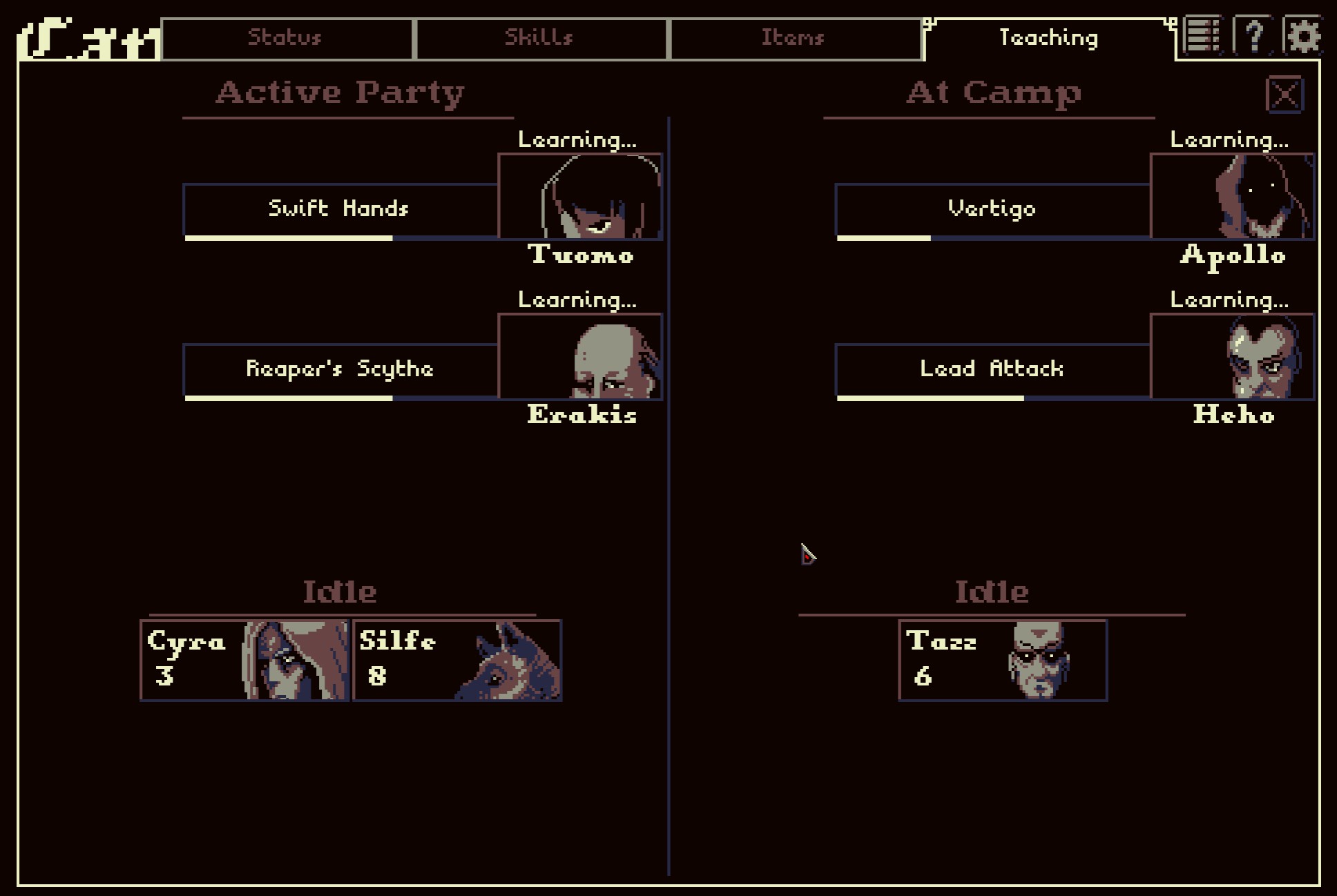
What often happens during a run is that one character (Brom) will have access to a Skill that another character (Daz) can better use in their build. An example might be the skill Lifeboost, which increases Max HP by 15% and is good on everyone but especially front liners. If you have enough AP, Brom can teach Daz that Skill, and after a few battles Daz will perform much better as the party tank. This even extends to another Character’s Skill Group; say you have Ace who has the Summer Mage skill group and has mastered powerful Fire Elemental magic. You can have her learn Gaius’s Cryomancer skill group and then spend her AP from then on rounding out her skills with Ice Elemental magic.
You will generally gain over 4 characters in a run, so many have to sit back at Camp (don’t worry, they level along with the rest of the party). Their most important role becomes being Skill Teachers, as the AP they gain from levels can be spent on their pupils as well. If you have knowledge about how Skill Tiers and Groups work, you can even Develop a Skill on a Character to mutate into another one, though it's a bit of a crapshoot to get exactly the right Skill you need. THYSIASTERY does very little to explain how any of this works. Instead it wants you to experiment and figure the system out yourself. Needless to say, this may rub some players the wrong way.
The complexity doesn’t just stay in the menus, but extends to the dungeon as well. Navigation and combat happen on the same plane so that enemies persist between both modes. When in combat mode, actors and enemies participating take turns in accordance to a timeline system, just like Grandia. Different actions change wait time until the next turn. Hitting elemental weaknesses and performing criticals make your turn come faster, while hitting enemy nullifications or missing attacks makes their turns come faster. To escape from a battle, you must end combat mode and physically move your party away from the enemy until they have lost sight of you. If you are not in combat and within the range of an aware enemy, they will take free attacks against you. Knowing when to initiate combat so that you maximize your turns versus when you end combat to reposition on the field is half the battle.
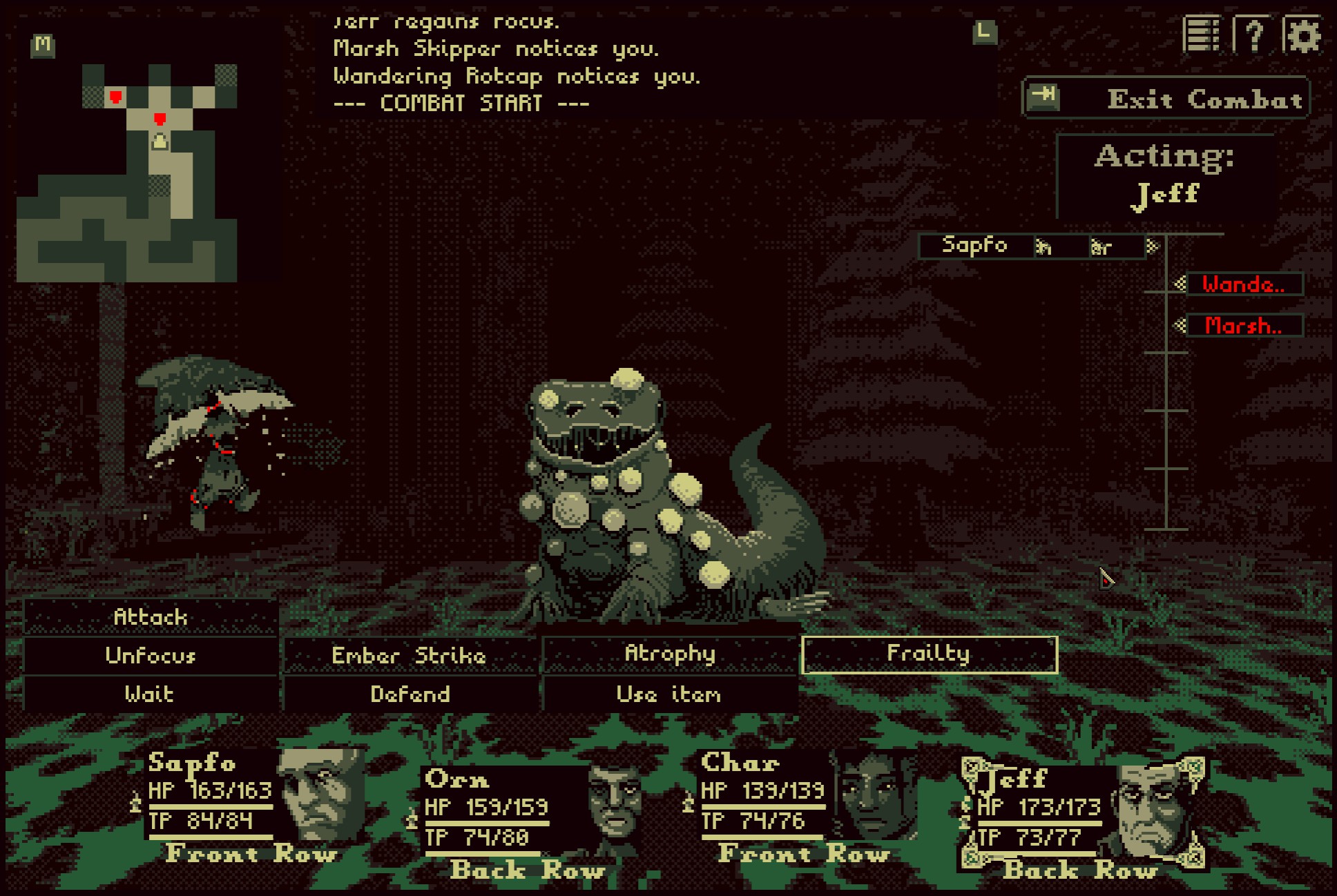
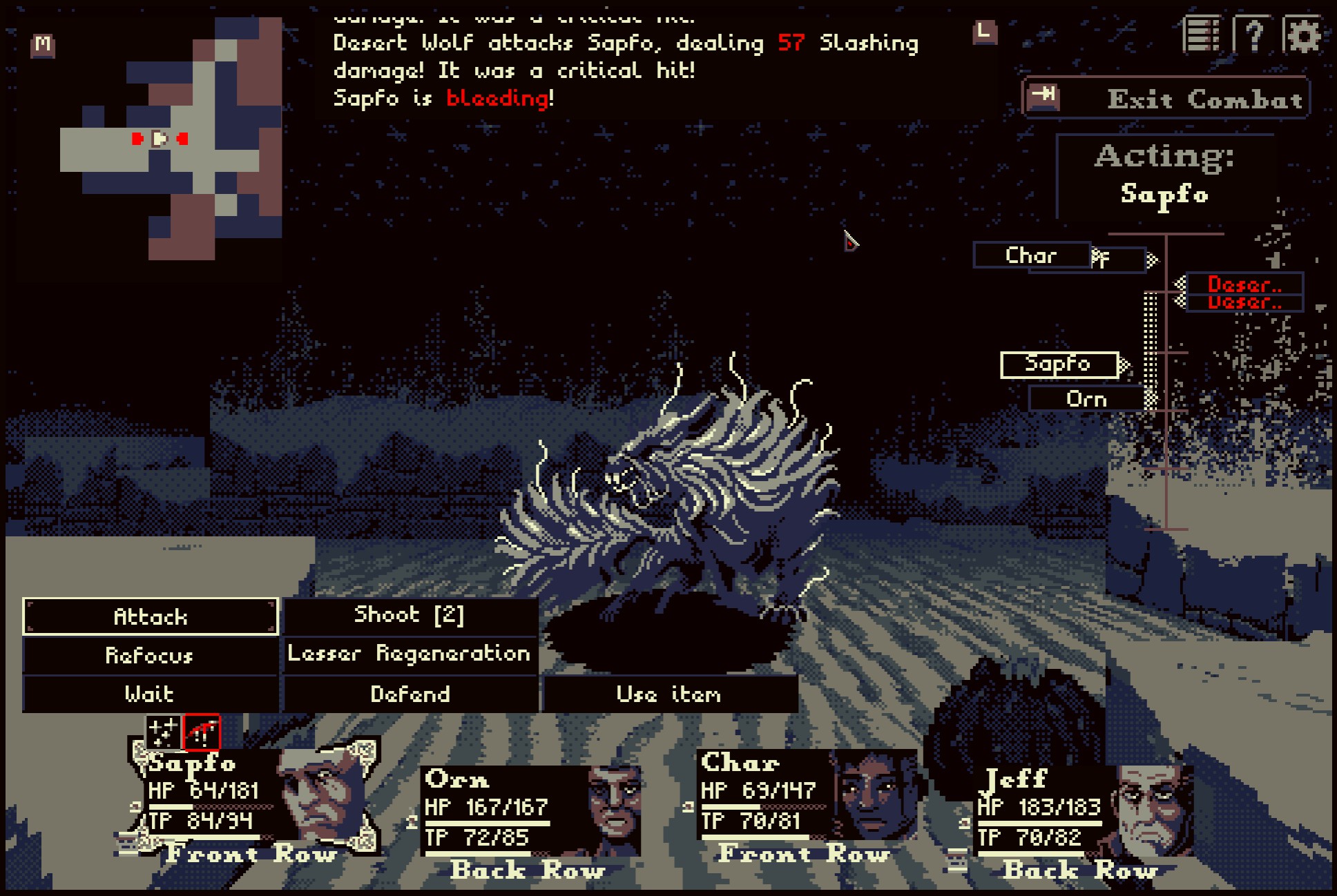
This is where the level layout comes in handy. While you want to take on one enemy at a time, you are in a better position to do so if you can funnel enemies down doorways or corridors rather than wide open rooms. Enemies have a habit of “jumping in” when they become aware of your position, even if you are locked in combat with others. The worst case scenario is when you are attacked from behind while managing an enemy from the front. Then you must clear the way on one end before you can safely reposition. Managing enemies at different ranges becomes a sub-game in combat, as when an enemy is out of position, they will need to waste a turn moving towards you. (This can happen to you as well, so it is good to have methods of fighting at range). Outside of Skills, the game provides consumables like Grenades to deal damage at range, as well as Gun Relics that use a universal Ammo item and can be equipped as an accessory by any character regardless of stats or skills. There can be a lot of options to juggle on any given turn, meaning plenty of room to make mistakes.
Last but not least is Focus management. Focus is a consumable resource characters get starting Level 3, which is key for dealing with the attrition that comes with crawling THYSIASTERY’s labyrinth. Focus increases the power and accuracy of skills while letting you use them at a massive TP discount. Spacing out encounters such that each starts with a party that is fully Focused is a great way to build momentum during your run or initiate Boss fights on a strong footing. Notably, Focus does not extend its benefit to Healing skills, so Healers will have to pay the hard cost of their Skills every time. While inelegant, this is a good move by the designers as cheap healing usually trivializes attrition. Each fight matters more if you have the scars to show for it.
The final stratum of the THYSIASTERY experience is that it's bloody hard!
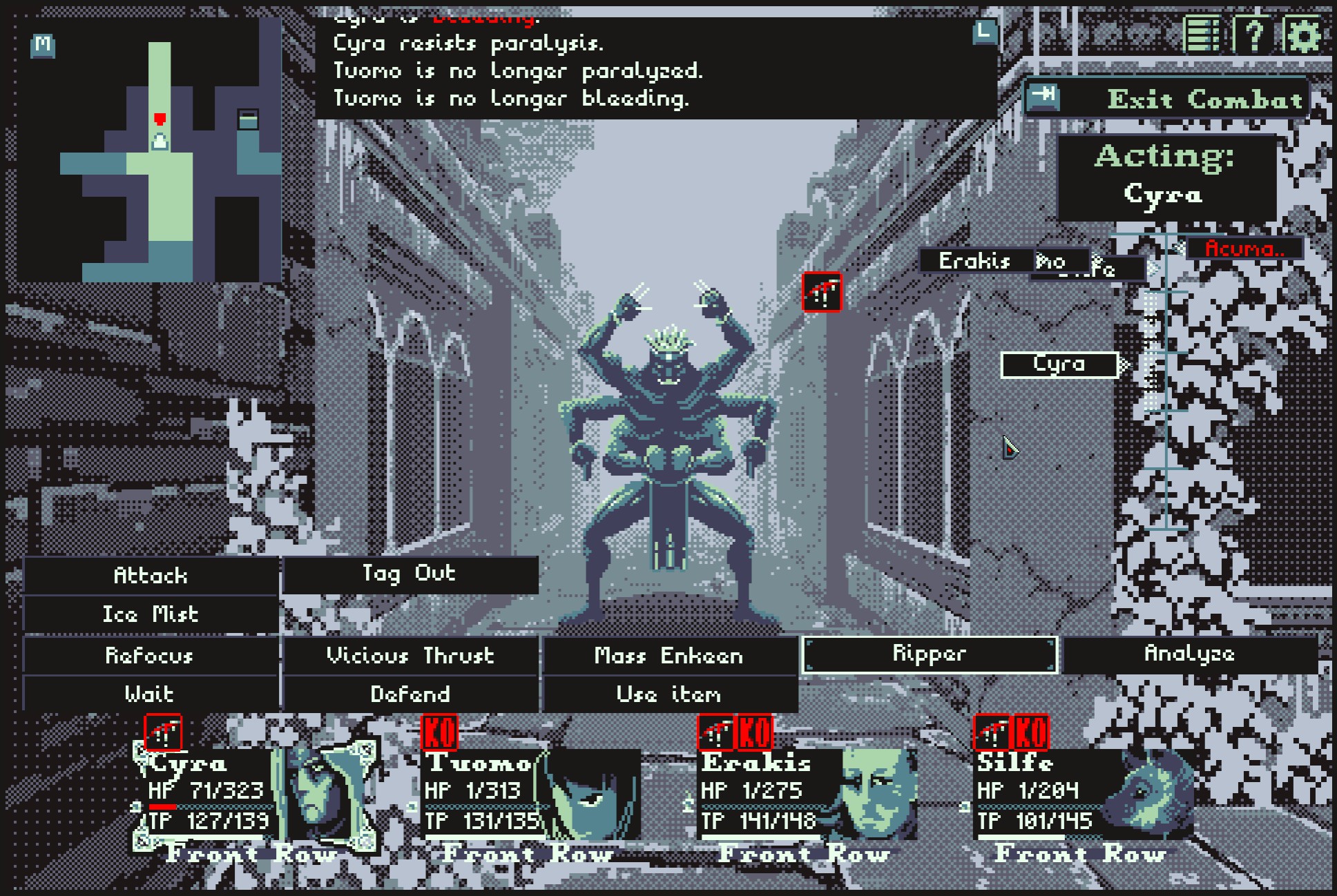
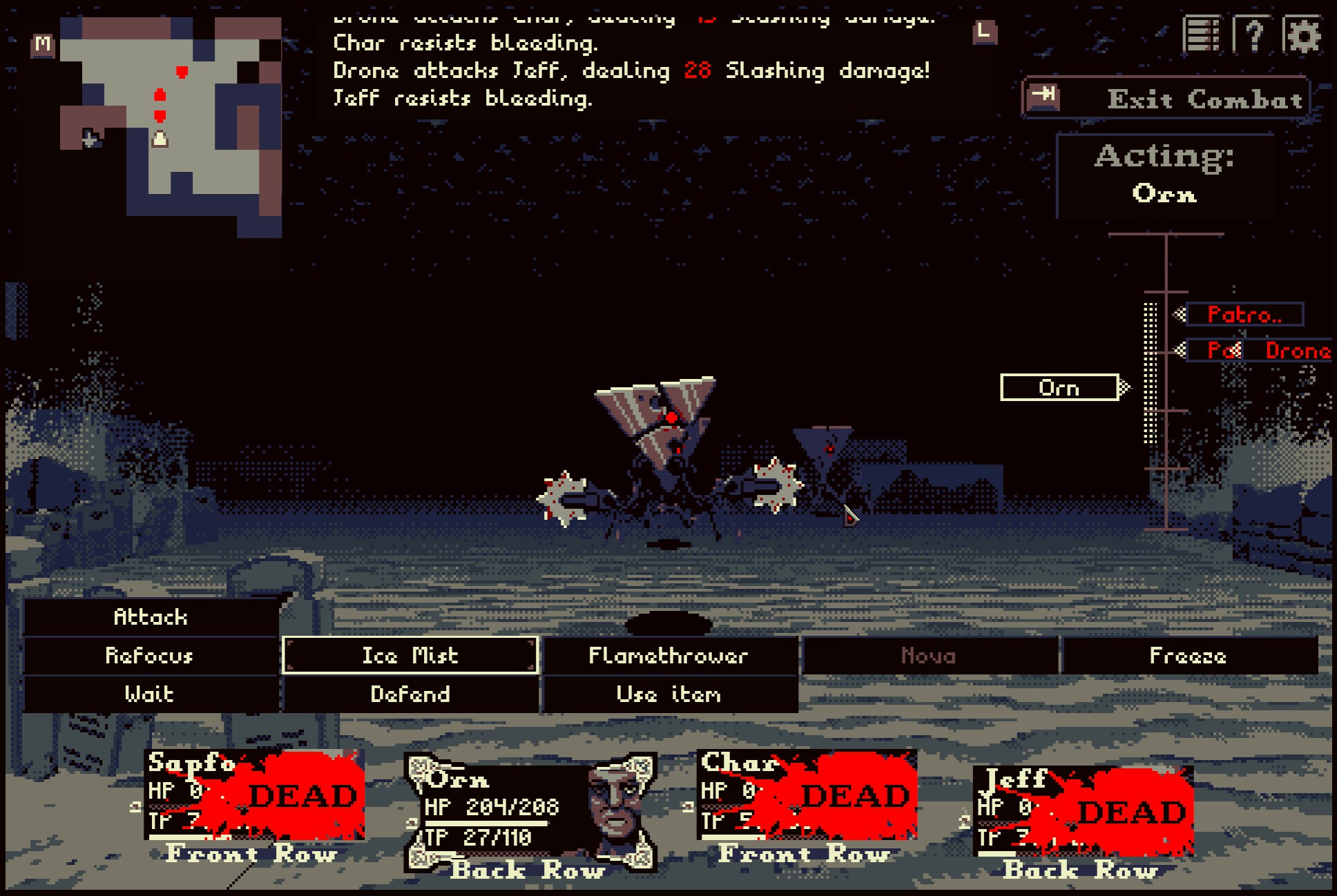
Enemies are not afraid to go after characters with low HP, or in some cases end them with a single deadly stroke. The game is good at telegraphing when a deadly attack will target a single character or when a big area-of-effect effect is coming, so that your party has a chance to heal up or defend against it. But sometimes the timeline works out so that the threatened character doesn’t get an intervening turn, leading to a brutal demise. While characters that go down to 0 HP get KO’d, a roll is made to see if the blow is lethal or not, just like in Darkest Dungeon.
If the character survives, they are left with a Wound which reduces their chances of surviving the next lethal blow. Wounds can be healed over time but they ramp up the tension going into a fight, as you don’t know if it will be your character’s last. The death of a character can be a minor setback or a run ending one depending on what role they were playing for your team. If a damage dealer gets killed, it’s not the end of the world as you transfer their items to their replacement. If your healer or key skill user dies, it can be the start of a long and painful death spiral.
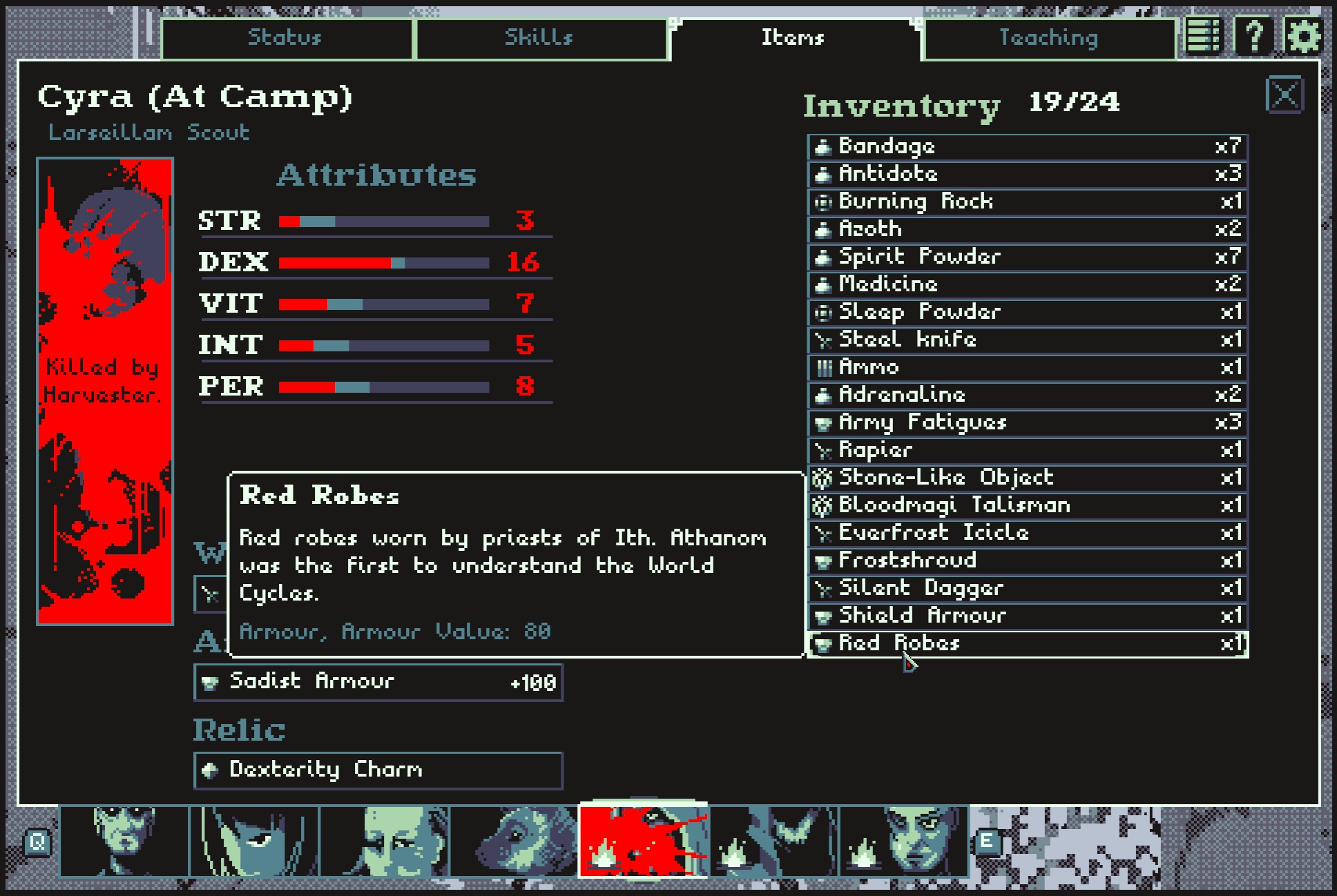
Turns pass each time the player moves in the dungeon, takes actions during combat or rests at the camp. What the game doesn’t tell you is that the dungeon stratum has a timer. After it elapses, a special enemy called the Harvester hones in on your position. You only get vague hints as to when the Harvester is coming, like how spent your Campfire is, or whether your party feels a sense of unease while resting.
When it finally shows up it can be a terrifying encounter. The Harvester can be beaten, but if your party meets them too early it is sure to result in the death of a character. There is even a floor later in the run where you are practically guaranteed an encounter by this terrible creature due to the extended size of the floor. While the Harvester serves as a good countermeasure to prevent players from spending too much time grinding a stratum, running into it can feel like the game pulling a rug out from under you if you don’t know what to expect.
There is no meta-progression in the game save for information in your Logbook and difficulty modifiers that can be earned from successful runs. While this may be a controversial opinion, this is my preferred form of roguelike, where there is no requirement to do extra runs for rewards from an extrinsic system. It is possible to luck into a win on your first run, though unlikely given the limited tutorialization of some of the game’s systems. THYSIASTERY is primarily knowledge-gated; once you have a handle on what Skill and Gear synergies work and what Enemies are weak/strong against, you have a reasonable chance of overcoming those challenges in the future. Still I am sympathetic to players who make it two hrs into a run only to realize their party won’t be able to clear the final boss and then have nothing tangible to show for it. That game doesn’t even give you the dignity of an Abandon Run button really cements the feeling of bleakness.
So, you might be asking by now: what makes these selling points? Don’t these make the game suck and waste your time? Isn’t this the opposite of what you want from a tough as nails dungeon crawler?
The arc of a dungeon crawler is taking a chaotic situation outside your control and finding ways to grow your party to be able to bring those variables within your sphere of influence and into some semblance of progress. You go from risking life and limb fighting low level Rats and Slimes to min-maxing your party members to soloing Gods and Demons before they even take their turn. The empowerment fantasy though is only one means of experiencing that arc. THYSIASTERY inverts the formula: Can you make the best of a bad situation? Are you able to eke out victories when time and resources are not on your side?
 co
co
THYSIASTERY’s use of high variance is purposeful. Its designers want to break players from established play patterns and engage with the large pool of Skills and Gear so that they discover synergies they might not have anticipated. There is a deep joy this game is able to give you in making the best out of a bad starting hand and slowly getting it to work in your favor. It may not be the ideal build but it’s the one that you could throw together despite the hardships you have experienced to get a run clear. You might never get to experience that exact set of circumstances again due to how skill randomization works; the next time you clear it will be through some new method entirely.
Its approach brings to mind Final Fantasy challenge runs like the Solo Warrior / 4 White Mage party for Final Fantasy 1 or Four Job Fiesta for Final Fantasy V, where in an otherwise min-maxable design space you are given constraints that push you towards unorthodox solutions. Suddenly the White Mage is using Muddle on the Liquid Flame boss fight to make it deal damage to itself, when that option may have never occurred to you if you ran your otherwise “balanced” party.
THYSIASTERY embraces those unorthodox discoveries, those happy little coincidences that remind you of what fascinated you about crunchy dungeon crawlers in the first place. It does so by expertly compressing the equivalent of a 25 - 30 hr game experience into a 2 - 3 hr one you can experience again and again with a dizzying number of character and gear combinations. I don’t believe THYSIASTERY’s purpose is to replace or streamline those classic DRPG experiences, but rather to serve as a side dish you can play between your larger offerings but still taps into the same grooves in your brain that spark with delight when you narrowly avoid getting beheaded by a Vorpal Bunny. It does so in a manner that respects its players' intelligence and time. You can get a run clear in THYSIASTERY within 8 - 10 hrs, making it a perfect one weekend game. Its achievements are also quite reasonable to chase after getting you to try for different play outcomes, though The Zenith (filling out your Skills Logbook) can be a chore.
Much like its parties of lost souls, THYSIASTERY walks on a difficult tightrope to find its audience. It is on the one hand selling its roguelike structure to dungeon crawler oldheads who want strict hand-crafted expressions of masochism. And on the other it is selling high variance gameplay to roguelite players who want more control over their repeated random excursions. You can see that the game has earned many negative reviews on Steam over pain points of “balance” and “too much RNG”. While there is some truth to that, I find it disappointing that so many people have come to these conclusions within the first hour and demanded that the game change rather than adapting themselves.
There is a version of THYSIASTERY that has fixed Characters with names and backstories, has none of the gear and skill randomization for Skill Groups, is much more explicit about its setting and narrative, and has meta-progression elements that make every run worth it. It’s a version of the game that might sell better and attract more positive acclaim. But it rings false to the experience DIRGA has achieved here through their specific vision of the Wizardry Roguelike. While I hope that the developers take feedback and make changes they feel like they need, I pray they preserve the core of what makes THYSIASTERY work for me: its incredible atmosphere, the depth of its stacking systems, the chaos of its high variance and the nail biting tension that keeps you on edge as you traverse its labyrinth.
In an ever crowding DRPG landscape, THYSIASTERY cuts through the fog like a beam of light. Neither wallowing in the faded nostalgia of yesteryear nor hyperfixating on ever more specific refinements of established formulae, the game grows an exciting new branch for the genre that I am keen to see DIRGA and their peers develop further. If anything I have said in this review has appealed to the crawler gremlin living in your brain, then I highly encourage checking out the game’s website and purchasing it on Steam.
May you avoid the jaws of defeat and find your way out of the … T H Y S I A S T E R Y …
P.S: Shout out to Finnish game devs for coming out of the woods once every decade and dropping bangers that revolutionize the DRPG genre. Legend of Grimrock was incredible when it dropped and I hope in time that THYSIASTERY can follow in its well worn footsteps. If you are into modding, I recommend checking out the Lost City mod for LoG 2 if you are looking for a bigger meal after THYSIASTERY. May do a piece on it if folks want that.
P.S.2: If you want to learn more about THYSIASTERY's team, there's this great interview that I found where they discuss the design and the reception and future of the game.